


Table of Contents
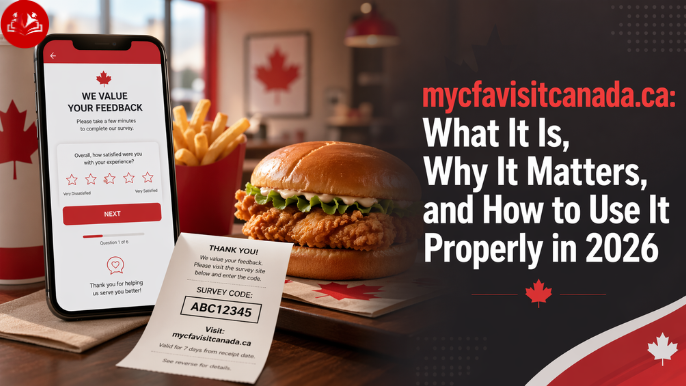
If you search for mycfavisitcanada.ca, you are probably trying to do one of three things: complete a Chick-fil-A Canada receipt survey, understand whether the site is legitimate, or figure out how the reward process works.
That makes this topic more important than it first appears. A simple survey URL sits at the intersection of customer trust, loyalty marketing, digital redemption, and brand operations. For consumers, it is about getting a valid offer and avoiding fake links. For operators and marketers, it is a practical example of how a large brand gathers structured feedback and turns it into measurable retention activity.
Based on Chick-fil-A Canada’s official support pages, the company’s receipt survey FAQ confirms that some printed receipts include a survey invitation, and its official help article specifically directs eligible users to the “My CFA Visit” page at mycfavisitcanada.ca. The same support area also makes clear that not every receipt includes an invitation.
So the short answer is this: mycfavisitcanada.ca appears to be the official survey destination referenced by Chick-fil-A Canada for receipt-based customer feedback.
This guide explains what the site is, how to use it correctly, how to think about it strategically, and what it teaches us about modern customer experience systems.
What Is mycfavisitcanada.ca?
mycfavisitcanada.ca is the survey website referenced by Chick-fil-A Canada for customers who received a valid survey invitation on a printed receipt. Chick-fil-A Canada’s official support page says eligible customers can find the serial number or Survey ID Code at the bottom of their receipt and visit the “My CFA Visit” page to take the survey.
Simple definition
It is a receipt-based customer feedback portal tied to Chick-fil-A Canada’s post-purchase experience.
Key characteristics
- It is connected to a printed receipt invitation
- It uses a serial number or Survey ID Code
- Not every receipt qualifies for the survey
- It is part of Chick-fil-A Canada’s official customer support and promotions flow
Beginner-friendly explanation
Think of it like this:
- You buy food at Chick-fil-A Canada.
- Some receipts invite you to take a survey.
- You enter the code from the receipt.
- You share feedback about the visit.
- You may receive a promotional offer tied to that survey flow.
That is the business model behind many modern quick-service restaurant feedback programs.
Why mycfavisitcanada.ca Matters
At first glance, this looks like a simple coupon or survey page. In reality, it matters for several reasons.
1. It is a trust checkpoint
When users see a branded but unfamiliar domain, they often wonder whether it is safe. That concern is valid. The strongest signal here is that Chick-fil-A Canada’s own support page links users to mycfavisitcanada.ca from its official website.
2. It connects feedback to customer retention
Survey programs are not just about collecting comments. They are designed to:
- Measure visit quality
- Detect operational issues
- Encourage a repeat visit
- Build first-party customer data
- Improve store-level decision-making
For a restaurant chain, that is a powerful loop.
3. It reflects a broader loyalty and CX trend
From 2026 onward, brands are doubling down on systems that combine:
- post-visit feedback,
- offer redemption,
- CRM enrichment,
- and behavior-based retention.
A survey portal like mycfavisitcanada.ca is a small but useful case study in digital customer experience infrastructure.
Core Components of mycfavisitcanada.ca
To understand the topic well, break it into its operational parts.
Table: Core elements of the survey flow
| Component | What it does | Why it matters |
| Printed receipt invitation | Tells the customer they are eligible | Limits survey access to actual transactions |
| Survey ID or serial number | Connects the survey to a specific visit | Helps validate authenticity |
| Survey portal | Collects structured feedback | Centralizes brand data |
| Reward or offer delivery | Encourages return visits | Improves repeat purchase rate |
| Support/FAQ layer | Resolves redemption problems | Protects customer trust |
1. Receipt-triggered access
Chick-fil-A Canada’s support content says the survey is only available if it is indicated on the printed receipt, and the code appears at the bottom of that receipt.
This matters because it reduces abuse. A brand does not want unlimited public participation unrelated to real purchases.
2. Verification through receipt data
The code or serial number acts like a lightweight verification system. It helps confirm:
- that a transaction happened,
- that the invite is recent,
- and that the survey belongs to a real store visit.
3. Offer-based incentive design
Chick-fil-A Canada’s survey FAQ includes questions like how to get free food, whether substitutions are allowed, and when the free sandwich expires. That strongly signals the survey is tied to a promotional redemption flow, not just a feedback form.
4. Customer support escalation
The FAQ also includes support paths for:
- unreadable survey code,
- wrong email address,
- expired code,
- and missing reward issues.
That is important operationally. Any incentive-based system needs a fallback process or users lose trust quickly.
How to Use mycfavisitcanada.ca Step by Step
Here is the practical framework.
Step 1: Check whether your receipt includes a survey invitation
Do not assume every receipt qualifies. Chick-fil-A Canada explicitly says not every receipt includes an invitation.
Look for:
- survey wording,
- a survey ID code,
- or a serial number near the bottom of the receipt.
Step 2: Use the exact printed information
Enter the code exactly as shown. Avoid guessing, skipping digits, or using a code shared online.
Why? Chick-fil-A’s support language warns that third-party survey codes, digital coupons, or QR codes from outside authorized channels cannot be verified as valid offers.
Step 3: Access the official survey page from the official brand context
The safest route is to start at the Chick-fil-A Canada support page and follow the “My CFA Visit” link from there. Chick-fil-A Canada’s official FAQ is the strongest reference point for legitimacy.
Step 4: Complete the survey honestly
Most survey systems ask about things like:
- speed of service,
- friendliness,
- order accuracy,
- cleanliness,
- and overall satisfaction.
Actionable feedback is more useful than emotional venting. If something went wrong, be specific.
Step 5: Save your confirmation or reward details
If the survey produces a reward email or redemption offer, keep:
- the receipt,
- the code,
- and any email confirmation.
This is useful if something goes wrong later.
Step 6: Redeem within the allowed time
If the offer has an expiry window, use it before it lapses. Chick-fil-A Canada’s FAQ includes a specific question about when the free sandwich expires, which tells you expiration management is part of the process.
Real-World Example
Let’s use a realistic consumer scenario.
Scenario
A customer in Ontario spends CAD 18.75 on lunch at Chick-fil-A Canada. The receipt includes a survey invitation with a serial number.
They go to the official survey page, complete the form in 5 minutes, and receive a reward tied to a future visit.
What the customer gets
- A chance to redeem an offer
- A clearer understanding of how the brand handles feedback
- A better reason to return
What the brand gets
- A verified feedback submission tied to a real transaction
- A chance to spot store-level service issues
- Another visit opportunity through the reward loop
Business lesson
This is not just a “free food” mechanism. It is a low-cost retention engine.
Advanced Insights: Best Case, Realistic Case, Worst Case
Best case
- The receipt is valid
- The survey code is clear
- The customer completes the survey quickly
- The reward is delivered without issue
- The customer redeems it and returns
Strategic meaning: the system increases both customer satisfaction and repeat traffic.
Realistic case
- The user completes the survey successfully
- The reward arrives, but the user has small questions about expiry, substitution, or eligibility
- The FAQ answers most of those questions
Strategic meaning: good support content reduces friction and support costs.
Worst case
- The code is unreadable
- The user visits the wrong site from a search result
- The reward does not appear immediately
- The user assumes the process is fake or broken
Chick-fil-A’s support materials address several of these failure points, including unreadable codes and missing reward issues.
Strategic meaning: small technical issues can damage brand trust unless the support layer is strong.
Stage-Based Breakdown
Stage 1: Awareness
The customer sees a receipt prompt and wonders:
- Is this real?
- Is it worth doing?
- What do I get?
This is where official linking from the brand site matters most.
Stage 2: Entry
The customer enters the survey code and begins the process.
This stage depends on:
- device compatibility,
- code clarity,
- and confidence in the URL.
Stage 3: Submission
The customer gives feedback. This is where brands gather high-signal operational data.
Stage 4: Reward delivery
This stage determines whether the experience feels fair. A broken incentive flow can cancel out the value of the survey.
Stage 5: Redemption and repeat visit
This is the commercial payoff. If the customer returns, the survey becomes part of a measurable growth loop.
Table: Consumer view vs business view
| Perspective | Main goal | Main risk | Main opportunity |
| Consumer | Complete the survey and redeem the offer | Fake links, invalid codes, missed expiry | Get a valid reward and help improve service |
| Brand | Collect useful feedback and drive return visits | Fraud, friction, poor follow-through | Better CX data and stronger retention |
Common Mistakes to Avoid

1. Assuming every receipt is eligible
This is false. Chick-fil-A Canada says not every receipt includes an invitation.
2. Searching random third-party sites for codes
That increases the chance of invalid or unauthorized offers. Chick-fil-A support warns that third-party-obtained codes and offers cannot be verified as valid.
3. Typing the wrong URL from memory
Users often confuse similar domains. The safest path is through the official Chick-fil-A Canada support page.
4. Throwing away the receipt too early
Keep it until:
- the survey is complete,
- the reward is delivered,
- and the redemption is finished.
5. Waiting too long
Survey codes and offers commonly rely on limited time windows. Even when the exact window varies, delay is unnecessary risk.
Expert Tips and Decision-Making Insights
Trust the brand path, not the search path
A good rule for survey sites is simple:
If a brand’s official website links to it, that is your strongest legitimacy signal.
That matters more than forum comments, social posts, or coupon blogs.
Treat small friction as a system signal
If many users struggle with:
- code readability,
- mobile access,
- or offer delivery,
that usually signals a design problem in the survey flow, not a user problem.
Think like an operator
For founders, marketers, and CX teams, mycfavisitcanada.ca is a reminder that the best survey systems do three things at once:
- collect feedback,
- create a reason to return,
- and reduce support friction.
If one of those breaks, the whole loop weakens.
Future Trends: 2026–2030
Survey-linked domains like mycfavisitcanada.ca may look simple today, but the underlying model is changing fast.
1. AI-assisted feedback analysis
Brands are increasingly using AI to:
- cluster comments,
- detect sentiment,
- flag recurring complaints,
- and generate store-level summaries.
That turns short survey submissions into more actionable operational intelligence.
2. Smarter personalization
Future survey systems will likely tailor rewards based on:
- visit frequency,
- order value,
- store performance,
- or loyalty status.
3. Stronger anti-fraud controls
Expect tighter validation around:
- code entry,
- geo-patterns,
- and repeated suspicious submissions.
4. Cross-channel integration
The survey, app, email, and loyalty offer may increasingly merge into one flow rather than separate experiences.
5. Reduced tolerance for poor UX
Users now expect fast mobile entry, instant confirmations, and transparent reward delivery. Slow or confusing systems will lose effectiveness.
FAQ: mycfavisitcanada.ca
Is mycfavisitcanada.ca legitimate?
Yes, Chick-fil-A Canada’s official support page links to mycfavisitcanada.ca as the “My CFA Visit” survey page for eligible receipt holders.
Do all Chick-fil-A Canada receipts have a survey code?
No. Chick-fil-A Canada says not every receipt includes an invitation to the customer experience survey.
Where do I find the survey code?
According to Chick-fil-A Canada, the serial number or Survey ID Code is printed at the bottom of the receipt when the survey is available.
What if I cannot read the code or the reward does not arrive?
Chick-fil-A Canada’s receipt survey FAQ includes support topics for unreadable codes, wrong email entry, and missing reward issues.
Can I use a code I found online?
You should not rely on third-party codes or offers. Chick-fil-A support says codes or coupons obtained from third parties may not be verifiable as valid authorized offers.
What is the purpose of mycfavisitcanada.ca?
Its practical purpose is to collect customer feedback tied to eligible Chick-fil-A Canada purchases and support a reward-based return-visit flow.
Why does this kind of survey matter to businesses?
Because it helps brands collect structured customer experience data, improve operations, and encourage repeat visits through targeted incentives.
Conclusion
mycfavisitcanada.ca is best understood as the official survey destination referenced by Chick-fil-A Canada for receipt-based customer feedback. It matters because it sits at the meeting point of trust, customer experience, loyalty marketing, and retention strategy.
For consumers, the right approach is simple:
- use only the code from your own receipt,
- start from the official Chick-fil-A Canada support path,
- and keep your receipt until the process is fully complete.
For business readers, the deeper lesson is even more useful:
small feedback systems can create real commercial value when they connect validation, insight, incentive, and support and more.
