


Table of Contents
Introduction
At first glance, njhjynjdrf looks like a random keyboard string. It does not read like a normal brand name, software tool, startup concept, or technical standard. That makes it confusing for readers, founders, marketers, and SEO teams who may see the term in search data, URLs, reports, test pages, analytics dashboards, or content briefs.
A quick search shows that a few websites discuss njhjynjdrf, but there is no strong evidence that it is an official company, widely accepted framework, or established technology term. Some pages describe it broadly as a mysterious concept, while one more practical interpretation frames it as an opaque identifier: a random-looking label that may be used as a placeholder, internal tag, tracking key, temporary filename, or automated system value.
That is the safest and most useful way to understand njhjynjdrf: not as a proven business trend, but as an example of how random-looking identifiers work in digital systems.
For founders and business professionals, this matters more than it may seem. In 2026, startups rely heavily on automation, analytics, artificial intelligence, data pipelines, customer tracking, product testing, and internal workflows. All of those systems use identifiers. Some are human-readable. Others look like njhjynjdrf.
If your business does not manage these identifiers carefully, you can create SEO issues, broken analytics, poor data quality, privacy risks, confusing reports, and messy product operations.
This guide explains what njhjynjdrf likely represents, why opaque identifiers matter, how to use them properly, and what founders should know before building systems around random strings.
What Is njhjynjdrf?
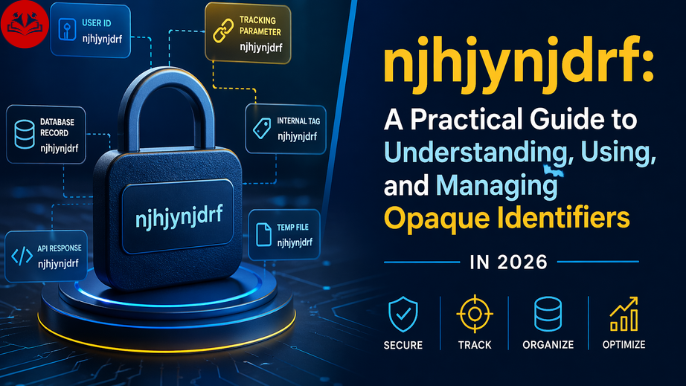
njhjynjdrf is best understood as a random-looking text string or opaque identifier. An opaque identifier is a label that has meaning to a system but little or no obvious meaning to a human reader.
In simple terms:
njhjynjdrf is not clearly a known product or standard. It is more useful to treat it as an example of a random identifier used in digital workflows.
An opaque identifier may appear in:
- Internal databases
- Testing environments
- Temporary URLs
- Tracking systems
- Placeholder content
- Product experiments
- File names
- API responses
- SEO test pages
- Automation workflows
For example, a startup might use a value like njhjynjdrf as a temporary campaign code, a test user label, or a unique key inside a database.
Simple Explanation for Beginners
Imagine your company has 10,000 users. Instead of identifying each user by name, your system gives each person a unique code. That code may look random, but it helps your software know who is who.
A human may not understand the code. The system does.
That is the basic idea behind an opaque identifier.
Key Characteristics of njhjynjdrf
| Characteristic | What It Means | Business Impact |
| Random-looking | It has no obvious meaning | Reduces human guessing but may create confusion |
| Short text string | Easy to store and pass between systems | Useful for URLs, tags, and records |
| Opaque | Meaning is hidden from users | Good for privacy, but bad for readability |
| Flexible | Can be used in many workflows | Helpful for testing and automation |
| Risky if unmanaged | Can appear in public pages by mistake | May harm SEO, trust, and analytics clarity |
The important point is this: random strings are useful only when they are controlled, documented, and placed correctly.
Why njhjynjdrf Matters
At a strategic level, njhjynjdrf matters because it represents a bigger issue: how businesses manage hidden identifiers in public and private systems.
Founders often focus on visible parts of a business: product design, landing pages, pricing, sales, and marketing. But behind the scenes, the company depends on invisible labels, keys, tags, and IDs.
These invisible pieces help the business operate.
They also create risk when handled badly.
Business Benefits of Opaque Identifiers
Opaque identifiers can help companies:
- Track users without exposing personal names
- Run product experiments cleanly
- Organize internal data
- Connect tools like CRMs, analytics platforms, and databases
- Prevent predictable URL patterns
- Separate test data from live customer data
- Reduce accidental disclosure of sensitive information
Strategic Importance
For a startup, identifiers are part of infrastructure. They affect:
- Product analytics
- Customer support
- SEO hygiene
- Conversion tracking
- Privacy controls
- Engineering quality
- Data reporting
- AI automation accuracy
A messy identifier system creates messy decisions. If your reports are filled with unclear strings and no documentation, your team may not know what is working, what is broken, or what needs attention.
Core Components of a Smart Identifier Strategy

To use a term like njhjynjdrf properly in a business or technical context, you need a clear structure.
1. Purpose
Every identifier should have a reason to exist.
Ask:
- Is it for tracking?
- Is it for testing?
- Is it for a user record?
- Is it for a campaign?
- Is it temporary or permanent?
- Is it safe to show publicly?
A random string without purpose becomes digital clutter.
2. Scope
Scope means where the identifier is allowed to appear.
For example:
| Identifier Type | Safe Location | Risky Location |
| Test string | Staging environment | Public indexed page |
| Campaign code | Analytics dashboard | Main page title |
| User ID | Backend database | Public profile URL if sensitive |
| API token | Secure server storage | Front-end code |
| Placeholder keyword | Draft content | Published SEO article |
If njhjynjdrf appears in public content by accident, it may confuse users and search engines.
3. Documentation
A good team documents identifiers.
Documentation should explain:
- What the identifier means
- Who created it
- Where it is used
- Whether it expires
- Whether it is safe for public display
- Which system owns it
This does not need to be complicated. Even a simple internal note can prevent major confusion.
4. Naming Rules
Not every identifier should be random. Some should be readable.
For example:
- Good readable campaign name: spring_launch_2026
- Good opaque internal ID: njhjynjdrf
- Bad public page slug: /njhjynjdrf-product-final-test-v2/
Use random strings for systems. Use clear names for humans.
5. Security and Privacy
Opaque identifiers can improve privacy because they do not expose obvious personal information. But they are not automatically secure.
A random-looking string is not the same as a password, token, or encryption key.
Founders should avoid using random identifiers as a replacement for real security controls.
Step-by-Step Framework for Using njhjynjdrf Properly
Here is a practical framework founders, marketers, and product teams can use.
Step 1: Identify the Use Case
Decide why the identifier exists.
Example use cases:
- Tracking a marketing campaign
- Testing a landing page
- Labeling a product experiment
- Creating a temporary file name
- Connecting database records
- Tagging AI-generated outputs
If the answer is unclear, do not use it yet.
Step 2: Decide Whether It Should Be Public
Ask one simple question:
Would a customer understand or benefit from seeing this?
If the answer is no, keep it out of public-facing content.
For example, njhjynjdrf may be fine inside a database. It is usually not ideal as a public blog title unless the article explains the term clearly.
Step 3: Create a Naming Convention
A naming convention helps your team avoid chaos.
Example:
| Use Case | Recommended Format | Example |
| Campaign | readable + date | founder_webinar_2026 |
| Test page | test + feature + version | test_pricing_v3 |
| Internal ID | random string | njhjynjdrf |
| Temporary file | date + purpose | 2026-demo-export-01 |
| SEO draft | keyword + status | opaque-identifiers-draft |
Step 4: Store It in the Right System
Do not store important identifiers in random spreadsheets, chat messages, or personal notes only.
Use structured tools such as:
- Product analytics software
- CRM platforms
- Project management tools
- Internal documentation
- Secure databases
- Version-controlled configuration files
Step 5: Monitor for Accidental Indexing
Sometimes test strings become public.
This can happen when:
- A staging page gets indexed
- A placeholder title is published
- A test URL is shared publicly
- AI content is pushed live without review
- Internal tags appear in metadata
SEO teams should regularly check whether random identifiers appear in search results.
Step 6: Clean Up Old Identifiers
Old random strings create confusion.
Set a review schedule:
- Weekly for active campaigns
- Monthly for analytics tags
- Quarterly for internal tools
- Before launch for all public pages
Remove or archive identifiers that no longer serve a purpose.
Real-World Example: Startup Analytics Scenario

Imagine a SaaS startup launching a new onboarding flow in 2026.
The team creates an internal experiment code: njhjynjdrf.
They use it to track users who see the new onboarding flow.
Scenario
- Monthly website visitors: 50,000
- Trial signups: 2,500
- Users included in test: 1,000
- Current activation rate: 28%
- New onboarding activation rate: 36%
- Average paid conversion value: $120
Result
| Metric | Old Flow | New Flow |
| Test users | 1,000 | 1,000 |
| Activation rate | 28% | 36% |
| Activated users | 280 | 360 |
| Difference | — | +80 users |
| Estimated value | — | $9,600 |
In this case, njhjynjdrf is useful because it helps the team track a real experiment.
But it becomes a problem if:
- It appears in the public page title
- It gets indexed by Google
- No one documents what it means
- The analytics team forgets which test it belongs to
- The same code is reused for another campaign
The lesson is simple: opaque identifiers are powerful when managed, but messy when ignored.
Advanced Insights and Scenario Planning
Founders should think about identifier systems in three scenarios: best case, realistic case, and worst case.
Best-Case Scenario
Your company uses identifiers cleanly.
- Every tag has a clear purpose
- Internal IDs never confuse customers
- Analytics reports are easy to understand
- SEO pages use human-readable titles
- Test strings are removed before publishing
- Privacy and security are handled properly
Result: your business scales with clean data and fewer operational problems.
Realistic Scenario
Your company uses many tools, and some identifiers become messy.
- Some campaign tags are documented
- Some test strings appear in reports
- A few old URLs contain random labels
- Teams sometimes ask what certain values mean
- Cleanup happens, but not consistently
Result: the business still works, but decision-making slows down.
Worst-Case Scenario
Your company has no identifier discipline.
- Random strings appear in public pages
- Search engines index test content
- Analytics reports are unclear
- Customer support cannot trace issues
- Sensitive tokens are exposed
- AI systems train on messy internal data
Result: poor SEO, weak trust, unreliable reporting, and possible security risk.
Stage-Based Breakdown for Founders
Early-Stage Startup
At this stage, speed matters. But you still need basic discipline.
Focus on:
- Simple naming rules
- Clear campaign tracking
- Avoiding public test pages
- Documenting important tags
- Separating test and live data
Do not over-engineer. Just avoid chaos.
Growth-Stage Business
As the business grows, identifiers multiply.
You need:
- Central documentation
- Analytics governance
- SEO checks
- Role-based access
- Better QA before publishing
- Clear ownership of tracking systems
At this stage, random strings like njhjynjdrf should never appear without context.
Enterprise or Scale-Up
At a larger scale, identifier management becomes part of data governance.
You need:
- Formal data dictionaries
- Security reviews
- Automated monitoring
- Privacy audits
- API documentation
- Event tracking standards
- AI data quality controls
For large companies, unclear identifiers can create reporting errors across multiple teams.
Tools and Resources
Here are useful tool categories for managing identifiers like njhjynjdrf.
| Need | Tool Type | Examples |
| Documentation | Knowledge base | Notion, Confluence, Google Docs |
| Analytics | Product analytics | GA4, Mixpanel, Amplitude |
| SEO checks | Site auditing | Screaming Frog, Ahrefs, Semrush |
| Project tracking | Workflow tools | Trello, Jira, ClickUp |
| Code management | Version control | GitHub, GitLab |
| Security | Secret scanning | GitHub secret scanning, GitGuardian |
| Data quality | Monitoring tools | BigQuery checks, dbt tests |
The exact tool matters less than the habit: document, monitor, review, and clean up.
Common Mistakes to Avoid
1. Publishing Random Strings Without Explanation
If njhjynjdrf is used in an article, landing page, or public URL, explain what it means. Otherwise, users may bounce quickly.
2. Treating Random Strings as Strategy
A random keyword is not a business strategy. It only becomes useful when connected to a clear purpose.
3. Reusing the Same Identifier Everywhere
Do not use one random string for multiple campaigns, users, tests, or files. That destroys clarity.
4. Forgetting SEO Impact
Random-looking pages can appear thin or confusing if they do not provide real value. Search engines reward helpful content, not empty keyword targeting.
5. Confusing Opaque IDs With Security
A random-looking ID can hide meaning, but it does not automatically protect data. Use proper security controls.
6. Ignoring Documentation
The person who created the identifier may leave the company. Documentation protects the business from memory loss.
7. Letting AI Tools Create Messy Labels
AI automation can generate placeholder names, draft slugs, and random tags. Review them before publishing.
Expert Tips and Psychological Insights

Think Like a User First
If a user sees njhjynjdrf, they may ask:
- Is this a typo?
- Is this safe?
- Is this a scam?
- Is this a code?
- Is this a real product?
Your content or product experience should answer those questions quickly.
Keep Human Names for Human Decisions
Use readable labels when people need to make decisions.
For example:
- Better: pricing-page-test-april-2026
- Worse: njhjynjdrf
Random strings are better for machines. Clear labels are better for teams.
Build Trust Through Clarity
A founder’s job is not only to build systems. It is to reduce confusion.
When users, investors, partners, or employees see unexplained random terms, trust can drop.
Use Randomness Carefully
Random identifiers are useful because they reduce predictability. But too much randomness creates operational friction.
The best systems combine:
- Machine-friendly IDs
- Human-friendly labels
- Clear documentation
- Strong access controls
Future Trends: 2026–2030
1. AI Will Create More Identifiers
AI agents will generate files, campaigns, drafts, tests, and workflows. Many will include automated labels. Companies will need stronger review systems.
2. Data Governance Will Become a Startup Priority
In the past, only big companies worried about data governance. By 2030, even small startups will need clean tracking and documentation.
3. SEO Will Reward Clearer Entity Signals
Search systems are getting better at understanding entities, brands, and user intent. Random terms without context may struggle unless the page provides genuine explanation and value.
4. Privacy Rules Will Push Better Identifier Design
Companies will need to avoid exposing personal data in URLs, analytics, and public records. Opaque identifiers can help, but only when designed properly.
5. Automation Will Require Better Naming Standards
As teams automate more work, naming systems will become more important. Poor labels will break workflows, reports, and AI outputs.
FAQ: njhjynjdrf
What does njhjynjdrf mean?
njhjynjdrf does not appear to have one confirmed official meaning. It is best understood as a random-looking string or opaque identifier that may be used in testing, tracking, placeholders, URLs, or internal systems.
Is njhjynjdrf a real company or software?
There is no strong evidence that njhjynjdrf is a widely recognized company, product, or software platform. Some websites discuss it, but the safest interpretation is that it represents a random or opaque identifier.
Why would a business use a string like njhjynjdrf?
A business may use a string like njhjynjdrf to label tests, track campaigns, identify records, create temporary files, or connect systems without exposing readable information.
Is njhjynjdrf safe to use in SEO content?
It can be used, but only if the content clearly explains the term and provides real value. Publishing thin content around random keywords can confuse users and weaken trust.
Should random identifiers appear in public URLs?
Sometimes, but only when necessary. Public URLs are usually better when they are readable, short, and descriptive. Random identifiers are more suitable for internal systems or secure technical workflows.
Can opaque identifiers protect user privacy?
They can help reduce exposure of personal information, but they are not a full privacy or security solution. Businesses still need access controls, encryption, secure storage, and proper data policies.
How should startups manage identifiers?
Startups should define naming rules, document important identifiers, separate test and live data, monitor public pages, and clean up old or unused tags regularly.
Conclusion
njhjynjdrf may look meaningless at first, but it points to an important business lesson. Modern companies run on identifiers, tags, labels, tracking codes, and automated system values. Some are clear to humans. Others look random.
The strategic question is not whether a string like looks strange. The real question is whether your business knows why it exists, where it appears, who owns it, and whether it creates value or confusion and more.
